
Your Go-To Resource for Business Technology & Cybersecurity
Stop Calling It a Chatbot: What AI Agents Actually Do for a Service Business in 2026
Most business owners hear "AI agent" and picture a chatbot widget. That's not what's happening in 2026.
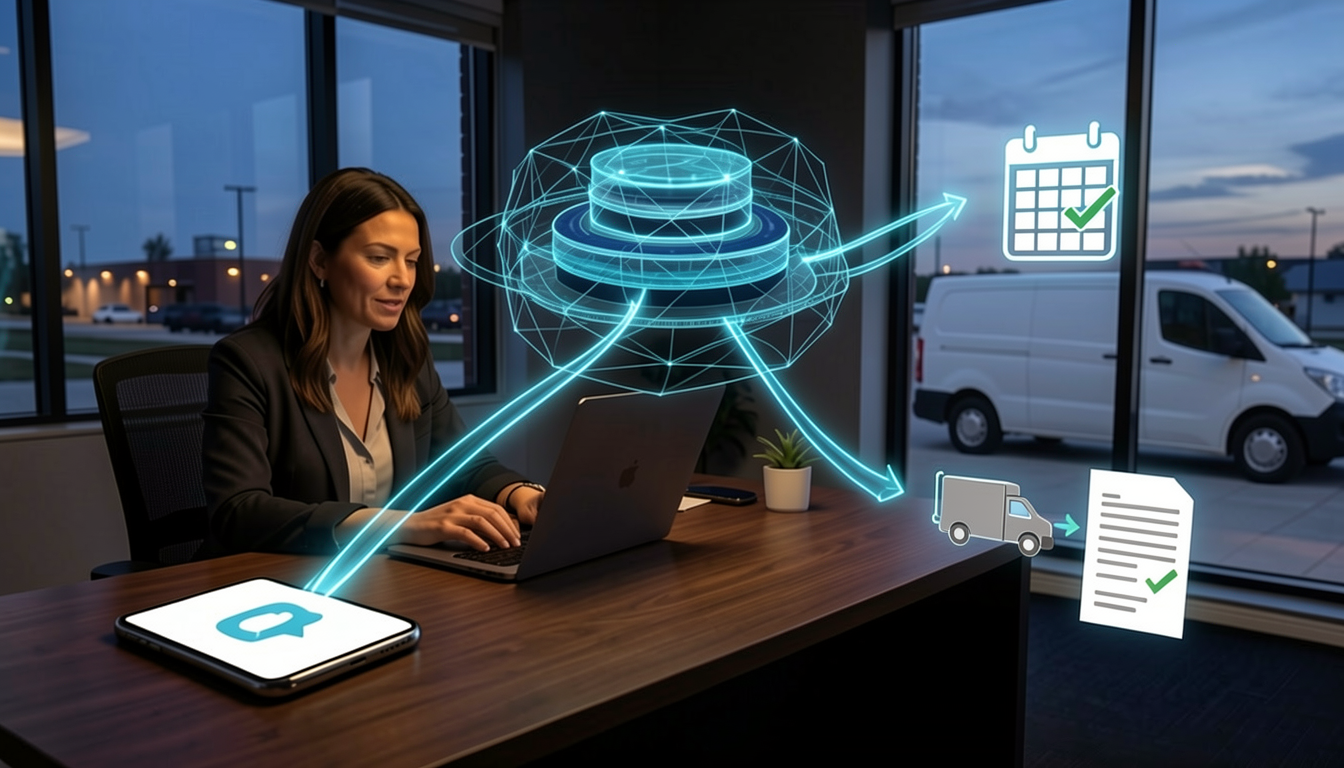
The real shift is trigger-based workflow orchestration. An AI agent wakes up when something happens in your business (a lead form, an invoice email, a call transcript) and completes a narrow operational job.
If you run a service business with high-frequency events in intake, dispatch, or billing, this is the practical AI conversation worth having.
The Market Confusion Is Real
SMB owners are still defaulting to "AI = chatbot" because that's what dominated early product announcements. Microsoft 365 Copilot and Copilot Studio have expanded the conversation, but the framing hasn't reached most service-business owners.
The result: businesses miss the higher-value use case. Repeatable events that happen 20, 50, or 100 times a week can trigger narrow reasoning and deterministic output. That's where ROI lives for a law firm, a plumbing company, or a CPA practice.
What Trigger-Based AI Agents Actually Look Like
Here are three concrete examples.
Law Firm: Intake Email Triggers Conflict-Check Summary and Draft Response
A potential client emails your intake address. The AI agent reads the email, cross-references your conflict-check database, and drafts a summary with a proposed response. Your paralegal reviews it and sends. The 15-minute manual task becomes a 2-minute review.
The trigger: new email. The narrow job: conflict-check summary and draft response. The output: structured text your team can verify.
Plumbing Contractor: Call Transcript Triggers Job-Assignment Draft
Your dispatcher takes a service call. The conversation is transcribed. The AI agent reads the transcript, identifies the job type, checks technician availability, and drafts the job assignment. Your dispatcher reviews and dispatches.
The trigger: call transcript. The narrow job: draft job assignment. The output: job ticket ready for review.
For contractors managing dispatch, operational readiness extends beyond AI workflows. The Contractor's Practical Guide to Ransomware and Phishing Readiness covers the security discipline that makes AI integration safer.
CPA Firm: Invoice-Aging Report Triggers Follow-Up Drafts
Your accounting system generates an invoice-aging report every Monday. The AI agent reads it, identifies accounts at 30, 60, and 90 days, and drafts follow-up emails tailored to each aging tier. Your team reviews and sends.
The trigger: Monday aging report. The narrow job: draft follow-up emails. The output: review-ready email drafts.
Why This Is Different from a Chatbot
A chatbot waits for someone to ask a question. A trigger-based AI agent wakes up when a business event happens and completes a predefined operational task.
Chatbots are reactive and general-purpose. Trigger-based agents are proactive and narrow. The value is in reducing time your team spends on repeatable, high-frequency work.
What This Means for Your Business
If you run a service business, you already have repeatable events. Intake emails. Dispatch calls. Billing reports. Renewal notices. The question is which event happens often enough to justify the work.
The threshold: if an event happens 20+ times a week and each instance costs your team 10+ minutes, that's the conversation.
Inman Technologies works with Fort Worth-area SMBs to identify high-frequency events, map trigger-based workflows, and build custom AI agents that fit into existing operations. We do paid discovery because every service business has different systems and operational priorities.
What You Need to Know Before You Start
Trigger-based AI agents require integration with your existing systems: email, CRM, dispatch software, accounting platform. If your systems don't talk to each other, integration becomes the bottleneck.
You need clean, consistent input data. If your intake emails are unstructured or call transcripts are low-quality, the AI agent will produce low-quality output.
Security and verification matter. AI agents produce drafts, not final decisions. Your team reviews before anything goes out. Your biggest security risk is often a habit, and introducing AI agents without verification protocols creates new risk.
FAQ
What's the difference between an AI agent and a chatbot?
A chatbot waits for someone to ask a question. An AI agent wakes up when a business event happens (email, transcript, report) and completes a narrow operational task without waiting for a question. Chatbots are reactive. AI agents are proactive and task-specific.
Do I need to replace my existing software to use AI agents?
No. AI agents integrate with your existing systems (email, CRM, dispatch, accounting). The integration work is part of implementation, but you don't replace your core software.
How do I know if my business is ready for trigger-based AI agents?
If you have a repeatable event that happens 20+ times a week and costs your team 10+ minutes per instance, you're in the conversation. If your systems are disconnected or input data is inconsistent, address those issues first.
What industries benefit most from trigger-based AI agents?
Professional services (legal, accounting, insurance), construction and trades (dispatch, estimating, follow-up), and any service business with high-frequency intake, billing, or renewal workflows. The common thread: repeatable operational events that require reasoning over unstructured input.
Next Step
Which repeatable event in your business happens 20+ times a week and costs you time? That's the discovery conversation.
Inman Technologies builds custom AI agent workflows for service businesses in Fort Worth and beyond. Learn more about our AI and automation services, or schedule a discovery call to map your high-frequency events, identify integration requirements, and scope what's possible.

Ready For A No-Nonsense Approach To IT?
Hire us to set your IT strategy up for sustainable success.
Learn about our proven No-Nonsense approach.
Get an IT roadmap designed specifically for you.
Fearlessly grow your business.
Schedule a Call
It all starts with a one-on-one IT consultation:
Fill in our quick form
We’ll schedule an introductory phone call
We’ll take the time to listen and plan the next steps
Enter your name and email to get started today.
Featured Posts
Stop Calling It a Chatbot: What AI Agents Actually Do for a Service Business in 2026
Most business owners hear "AI agent" and picture a chatbot widget. That's not what's happening in 2026.
The real shift is trigger-based workflow orchestration. An AI agent wakes up when something happens in your business (a lead form, an invoice email, a call transcript) and completes a narrow operational job.
If you run a service business with high-frequency events in intake, dispatch, or billing, this is the practical AI conversation worth having.
The Market Confusion Is Real
SMB owners are still defaulting to "AI = chatbot" because that's what dominated early product announcements. Microsoft 365 Copilot and Copilot Studio have expanded the conversation, but the framing hasn't reached most service-business owners.
The result: businesses miss the higher-value use case. Repeatable events that happen 20, 50, or 100 times a week can trigger narrow reasoning and deterministic output. That's where ROI lives for a law firm, a plumbing company, or a CPA practice.
What Trigger-Based AI Agents Actually Look Like
Here are three concrete examples.
Law Firm: Intake Email Triggers Conflict-Check Summary and Draft Response
A potential client emails your intake address. The AI agent reads the email, cross-references your conflict-check database, and drafts a summary with a proposed response. Your paralegal reviews it and sends. The 15-minute manual task becomes a 2-minute review.
The trigger: new email. The narrow job: conflict-check summary and draft response. The output: structured text your team can verify.
Plumbing Contractor: Call Transcript Triggers Job-Assignment Draft
Your dispatcher takes a service call. The conversation is transcribed. The AI agent reads the transcript, identifies the job type, checks technician availability, and drafts the job assignment. Your dispatcher reviews and dispatches.
The trigger: call transcript. The narrow job: draft job assignment. The output: job ticket ready for review.
For contractors managing dispatch, operational readiness extends beyond AI workflows. The Contractor's Practical Guide to Ransomware and Phishing Readiness covers the security discipline that makes AI integration safer.
CPA Firm: Invoice-Aging Report Triggers Follow-Up Drafts
Your accounting system generates an invoice-aging report every Monday. The AI agent reads it, identifies accounts at 30, 60, and 90 days, and drafts follow-up emails tailored to each aging tier. Your team reviews and sends.
The trigger: Monday aging report. The narrow job: draft follow-up emails. The output: review-ready email drafts.
Why This Is Different from a Chatbot
A chatbot waits for someone to ask a question. A trigger-based AI agent wakes up when a business event happens and completes a predefined operational task.
Chatbots are reactive and general-purpose. Trigger-based agents are proactive and narrow. The value is in reducing time your team spends on repeatable, high-frequency work.
What This Means for Your Business
If you run a service business, you already have repeatable events. Intake emails. Dispatch calls. Billing reports. Renewal notices. The question is which event happens often enough to justify the work.
The threshold: if an event happens 20+ times a week and each instance costs your team 10+ minutes, that's the conversation.
Inman Technologies works with Fort Worth-area SMBs to identify high-frequency events, map trigger-based workflows, and build custom AI agents that fit into existing operations. We do paid discovery because every service business has different systems and operational priorities.
What You Need to Know Before You Start
Trigger-based AI agents require integration with your existing systems: email, CRM, dispatch software, accounting platform. If your systems don't talk to each other, integration becomes the bottleneck.
You need clean, consistent input data. If your intake emails are unstructured or call transcripts are low-quality, the AI agent will produce low-quality output.
Security and verification matter. AI agents produce drafts, not final decisions. Your team reviews before anything goes out. Your biggest security risk is often a habit, and introducing AI agents without verification protocols creates new risk.
FAQ
What's the difference between an AI agent and a chatbot?
A chatbot waits for someone to ask a question. An AI agent wakes up when a business event happens (email, transcript, report) and completes a narrow operational task without waiting for a question. Chatbots are reactive. AI agents are proactive and task-specific.
Do I need to replace my existing software to use AI agents?
No. AI agents integrate with your existing systems (email, CRM, dispatch, accounting). The integration work is part of implementation, but you don't replace your core software.
How do I know if my business is ready for trigger-based AI agents?
If you have a repeatable event that happens 20+ times a week and costs your team 10+ minutes per instance, you're in the conversation. If your systems are disconnected or input data is inconsistent, address those issues first.
What industries benefit most from trigger-based AI agents?
Professional services (legal, accounting, insurance), construction and trades (dispatch, estimating, follow-up), and any service business with high-frequency intake, billing, or renewal workflows. The common thread: repeatable operational events that require reasoning over unstructured input.
Next Step
Which repeatable event in your business happens 20+ times a week and costs you time? That's the discovery conversation.
Inman Technologies builds custom AI agent workflows for service businesses in Fort Worth and beyond. Learn more about our AI and automation services, or schedule a discovery call to map your high-frequency events, identify integration requirements, and scope what's possible.
Enroll in Our Email Course

Learn How a No-Nonsense IT Strategy Benefits Your ComBullet listpany:
Strategies to allocate your IT budget efficiently
Enhance cybersecurity defenses on a bButtonudget
Ensure your technology investments continue to serve your business as it grows

© Copyright 2026 Inman Technologies. Built in partnership with Tech Pro Marketing. | Privacy Policy | SMS Opt-In


